Reading PassagePremium

What Is the Asthenosphere

Interactive passage with audio narration, comprehension questions, and printable PDF.

No ratings yet
Grades 5–8ScienceElaEnglish · SpanishInteractive · Printable
Aligned toMS-ESS2-1
Just this resource
$1.50
One-time purchase
Best value
Unlock everything
$49.99$24.99/yr
50% off until Sept 15 — 10,000+ resources
Renews at $49.99/year.

By completing this purchase you agree to our Terms of Use and Privacy Policy. Your subscription renews automatically until you cancel. You can cancel anytime from your account settings. All sales are final and non-refundable. Digital content is available for download in your account immediately upon purchase.

Unlock above to use these actions

What's included

Reading passage
Audio narration
Comprehension quiz
Writing activity
Glossary & flashcards
Differentiated version
Spanish translation

What Is the Asthenosphere preview and details

About this printable What Is the Asthenosphere science reading passage, NGSS-aligned (Grades 5-8)

science,ela
Written by Workybooks TeamPublished by Workybooks
Preview

Sample passage and quiz from What Is the Asthenosphere

Reading passage and comprehension quiz preview

What Is the Asthenosphere
ASTHENOSPHERE

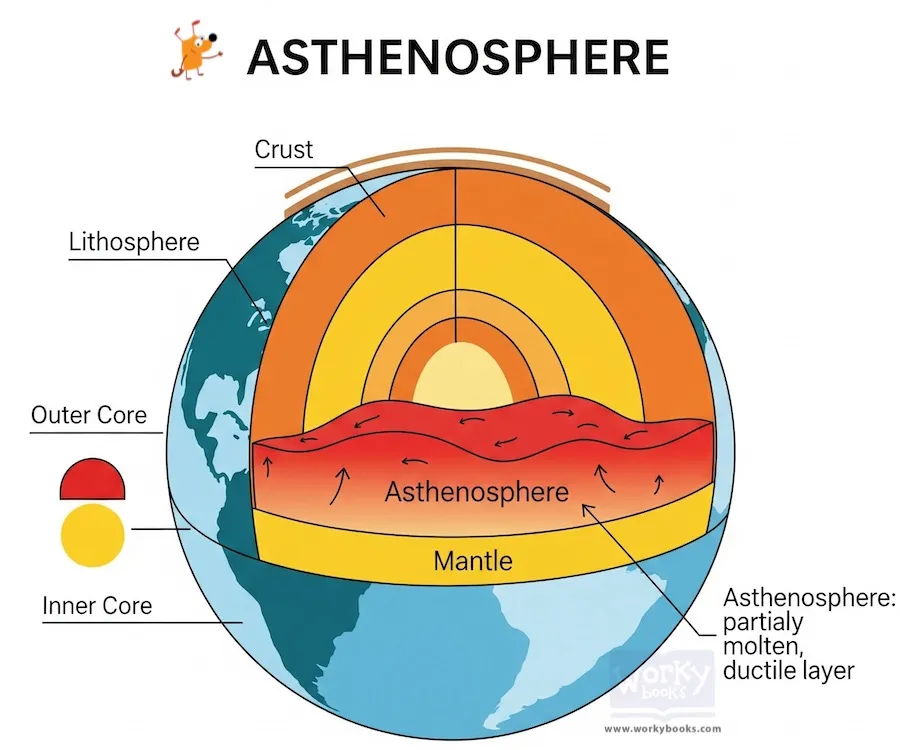
Right beneath Earth's rigid outer shell lies a layer that makes plate tectonics possible. This layer is called the asthenosphere, and it forms the upper part of the mantle. The asthenosphere is hotter, softer, and partly able to flow compared to the layer above it. Scientists explain that its name comes from a Greek word meaning "weak," which describes its key characteristic perfectly.

The asthenosphere sits directly below the lithosphere, which is Earth's rigid outer layer that includes the crust and upper mantle. Evidence shows that the asthenosphere extends from about 100 kilometers to roughly 350 kilometers below Earth's surface. The temperature in this zone ranges from about 1,300 to 2,400 degrees Celsius. These extreme temperatures cause the rock to behave differently than the solid rock above. The rock in the asthenosphere can flow very slowly, like thick putty or warm taffy. This flowing property is called plasticity.

The contrast between the strong lithosphere and the weak asthenosphere is crucial for plate movement. Because the rigid tectonic plates sit on top of the flowing asthenosphere, they can move across Earth's surface. The asthenosphere acts like a conveyor belt beneath the plates. Heat from deep within Earth creates convection currents in the mantle. These currents cause the asthenosphere to churn and flow. As the asthenosphere moves, it carries the plates along with it.

Scientists observe this process at work in places like Iceland. Iceland sits on the Mid-Atlantic Ridge, where two tectonic plates are slowly moving apart. The North American Plate and the Eurasian Plate separate at a rate of about 2.5 centimeters per year. This movement happens because the asthenosphere beneath Iceland flows and pushes the plates in opposite directions. Without the soft, flowing asthenosphere, the rigid plates would remain locked in place.

Understanding the asthenosphere helps scientists explain earthquakes, volcanic eruptions, and mountain formation. The asthenosphere's ability to flow makes it possible for continents to drift over millions of years. This layer completes the picture of how Earth's surface can shift and change. The asthenosphere and lithosphere work together as a system that shapes our planet's surface features.

Interesting Fact: The rock in the asthenosphere is so hot that it glows red, yet it remains solid because of the intense pressure from the layers above. Only about one to two percent of the rock is actually melted.

Comprehension quiz (10 questions)

1. What does the name 'asthenosphere' mean?

Strong
Weak
Hot
Flowing

2. Where is the asthenosphere located?

Above the lithosphere
In Earth's core
Below the lithosphere in the upper mantle
At Earth's surface

3. What is the approximate temperature range in the asthenosphere?

100 to 500 degrees Celsius
500 to 1,000 degrees Celsius
1,300 to 2,400 degrees Celsius
3,000 to 4,000 degrees Celsius

4. What does the term 'plasticity' refer to in the passage?

The ability of rock to break easily
The ability of rock to flow slowly like thick putty
The hardness of rock
The color of rock

5. How does the asthenosphere help tectonic plates move?

It pushes plates from below with explosive force
It acts like a flowing layer that carries plates along
It pulls plates downward into Earth
It freezes plates in place

6. What creates convection currents in the mantle?

Cold temperatures from space
Wind on Earth's surface
Heat from deep within Earth
Ocean water

7. At what rate do the North American Plate and Eurasian Plate separate in Iceland?

About 2.5 centimeters per year
About 10 centimeters per year
About 1 meter per year
About 25 centimeters per year

8. If the asthenosphere were completely solid and rigid, what would happen to tectonic plates?

They would move faster
They would remain locked in place
They would float on water
They would break into smaller pieces

9. The asthenosphere is part of Earth's crust.

True
False

10. The lithosphere is softer and weaker than the asthenosphere.

True
False
Who it's for

Perfect for the way you teach

Teachers
  • Build comprehension skills
  • Auto-graded quiz
  • Differentiated reading
Parents
  • Read together at home
  • Improve fluency
  • Quiet reading time
Homeschoolers
  • Reading curriculum support
  • Independent practice
  • Track Lexile growth
Topics

Reviews & Ratings

No reviews yet. Be the first to share your experience!

More reading you might love

20 more
Passage
Talus Slopes: Formation and Features - reading educational content
Grades 5–8

Talus Slopes: Formation and Features

science · MS-ESS2-1+2

Free
Passage
Biological Weathering: Types and Examples - reading educational content
Grades 5–8

Biological Weathering: Types and Examples

science · MS-ESS2-1+2

Free
Passage
Frost Wedging: How Ice Splits Rock - reading educational content
Grades 5–8

Frost Wedging: How Ice Splits Rock

earth and space science · MS-ESS2-1+2

$1.50
Passage
Chemical Weathering: The Breakdown of Rocks Through Chemical Reactions - reading educational content
Grades 5–8

Chemical Weathering: The Breakdown of Rocks Through Chemical Reactions

earth and space science · MS-ESS2-1+2

Free
Passage
Limestone Caves: Nature’s Underground Wonders - reading educational content
Grades 5–8

Limestone Caves: Nature’s Underground Wonders

science · MS-ESS2-1+2

Free
Passage
The Coldest City in the World: Yakutsk - reading educational content
Grades 5–8

The Coldest City in the World: Yakutsk

weather and climate · MS-ESS2-1

$1.50
Passage
Igneous Rocks - reading educational content
Grades 5–8

Igneous Rocks

earth and space science · MS-ESS2-1+1

$1.50
Passage
Sedimentary Rocks - reading educational content
Grades 5–8

Sedimentary Rocks

earth and space science · MS-ESS2-1+2

$1.50
Passage
Metamorphic Rocks - reading educational content
Grades 5–8

Metamorphic Rocks

earth and space science · MS-ESS2-1+1

Free
Passage
Scientific Inquiry in Earth Science - reading educational content
Grades 5–8

Scientific Inquiry in Earth Science

earth and space science · MS-ESS1-4+3

$1.50
Passage
Contour Lines and Elevation - reading educational content
Grades 5–8

Contour Lines and Elevation

earth and space science · MS-ESS2-2+3

$1.50
Passage
Weathering - reading educational content
Grades 5–8

Weathering

earth and space science · MS-ESS2-1

$1.50
Passage
Erosion - reading educational content
Grades 5–8

Erosion

earth and space science · MS-ESS2-1

$1.50
Passage
Stream Erosion and Deposition - reading educational content
Grades 5–8

Stream Erosion and Deposition

earth and space science · MS-ESS2-1

$1.50
Passage
Wind Erosion and Deposition - reading educational content
Grades 5–8

Wind Erosion and Deposition

earth and space science · MS-ESS2-1

$1.50
Passage
Glacial Erosion and Deposition - reading educational content
Grades 5–8

Glacial Erosion and Deposition

earth and space science · MS-ESS2-1

$1.50
Passage
Mass Movements - reading educational content
Grades 5–8

Mass Movements

science · MS-ESS2-1+1

$1.50
Passage
Soil Formation and Composition - reading educational content
Grades 5–8

Soil Formation and Composition

earth and space science · MS-ESS2-1

$1.50
Passage
Constructive and Destructive Forces - reading educational content
Grades 5–8

Constructive and Destructive Forces

earth and space science · MS-ESS2-1

Free
Passage
Mountains and Mountain Building - reading educational content
Grades 5–8

Mountains and Mountain Building

earth and space science · MS-ESS2-1+1

$1.50
Copyright © 2026 Workybooks. Made with ♥ in California.